
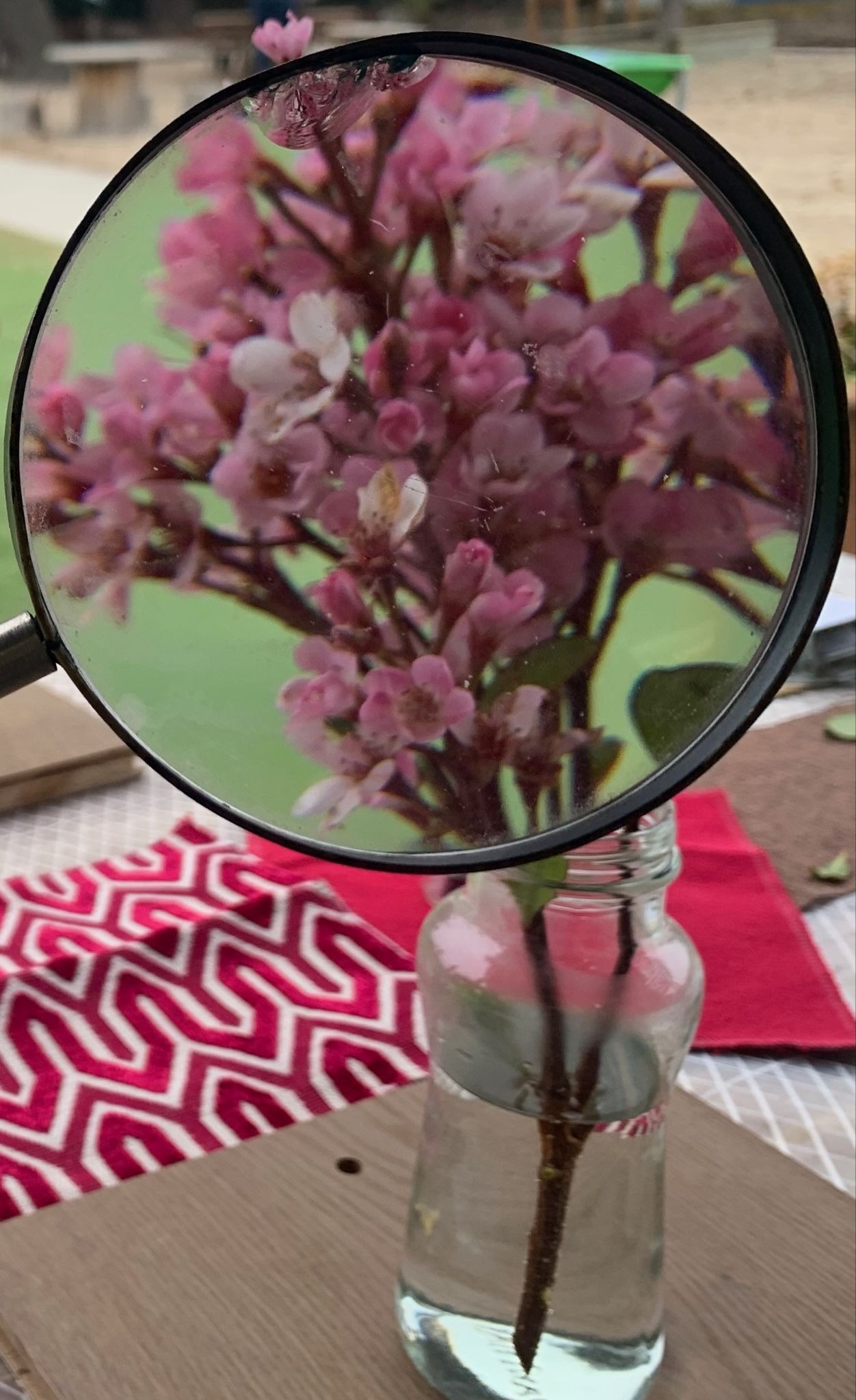
Beginning with Perspective
The work began not with paint, but with looking at nature.
Children had been lingering at the front of the school, drawn to the flowers growing there. They crouched low, leaned in close, traced petals with their eyes, and noticed details that were easy to miss when moving quickly. Rather than redirecting, we paused and asked what might happen if we looked at the flowers differently.
Back in the studio, flowers were cut together, in front of the children, with care and intention. This act mattered. It acknowledged the flowers as living materials and positioned them as collaborators in the work to come.
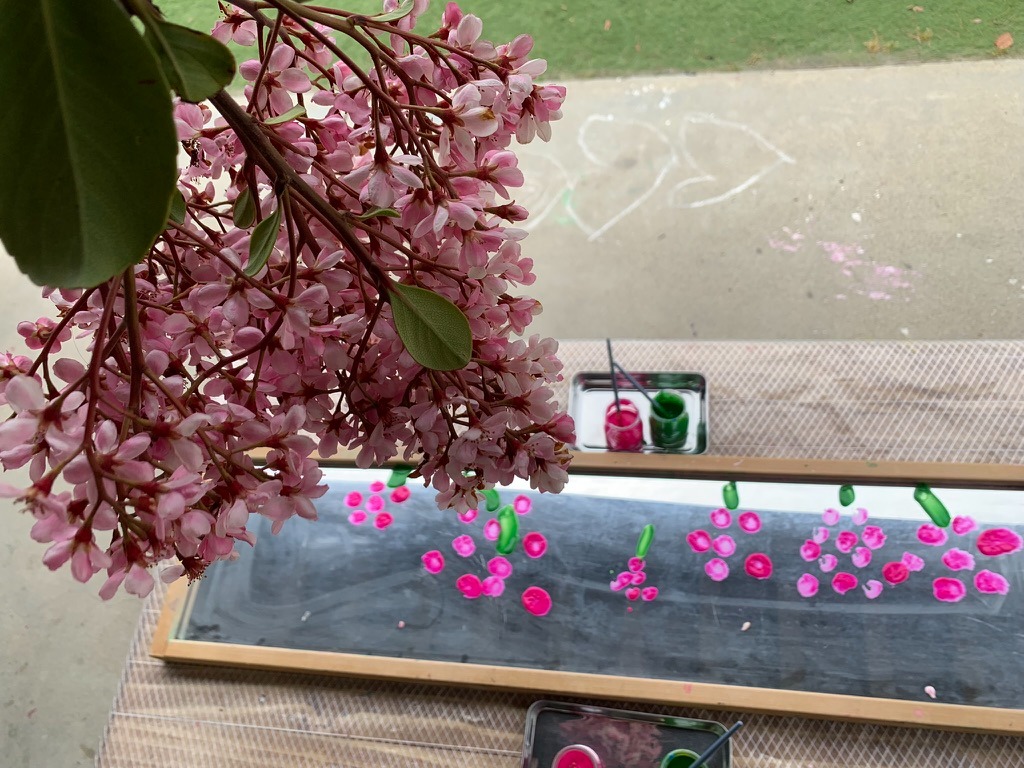
The flowers were then suspended from a bike wheel, allowing them to turn slowly and shift with even the slightest movement of air. A large mirror was placed beneath them.
The invitation was simple:
Paint what you see.
Seeing Through Reflection
The mirrors immediately changed the way children engaged. Flowers appeared inverted, fragmented, doubled. Some children noticed the way light moved across the petals. Others commented on how the flowers looked “upside down” or “like they’re floating.”
Children moved their bodies to see better—bending, crouching, stepping back. Perspective was no longer abstract; it was physical. What they painted was not the flower itself, but the experience of seeing it through reflection.
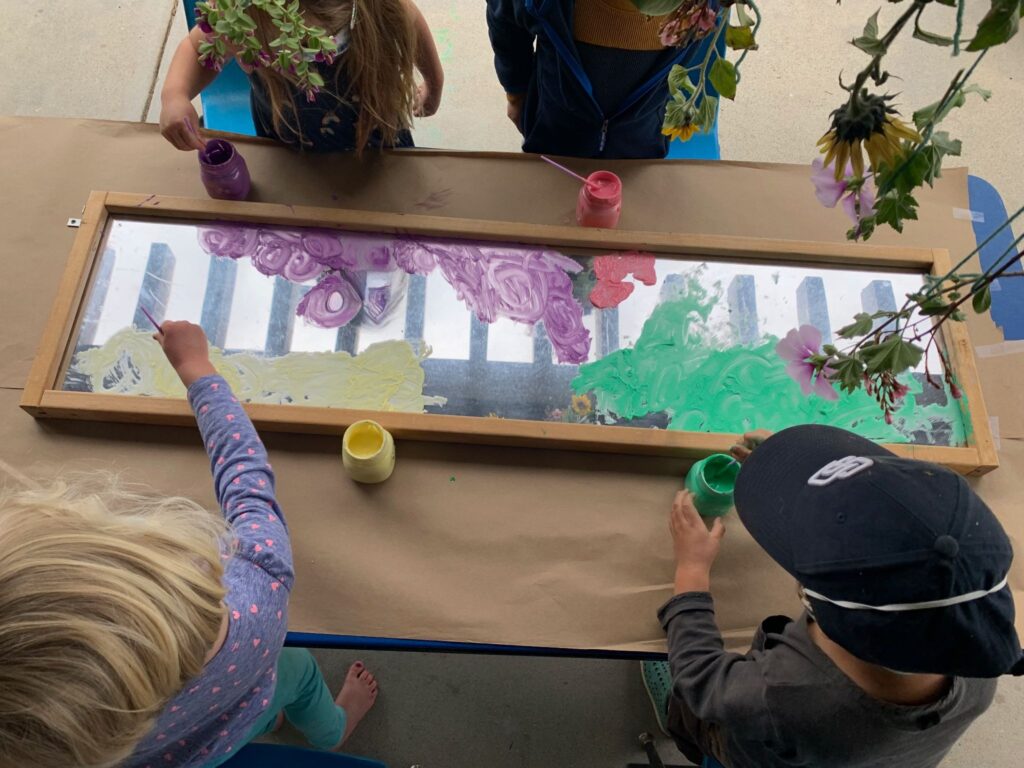
Paintbrushes were offered, and children worked carefully, translating movement, color, and shape onto paper. The paintings were loose and observational, capturing motion rather than detail.
And then something shifted.
A Question from the Children
As children painted, they continued to touch and examine the flowers. One child held a petal up to the paper and paused.
“What would happen,” they wondered, “if we used the flowers to paint?”
Another child added, almost matter-of-factly,
“The flowers will paint themselves.”
This question changed everything.
Rather than redirecting, we listened.
When Materials Lead
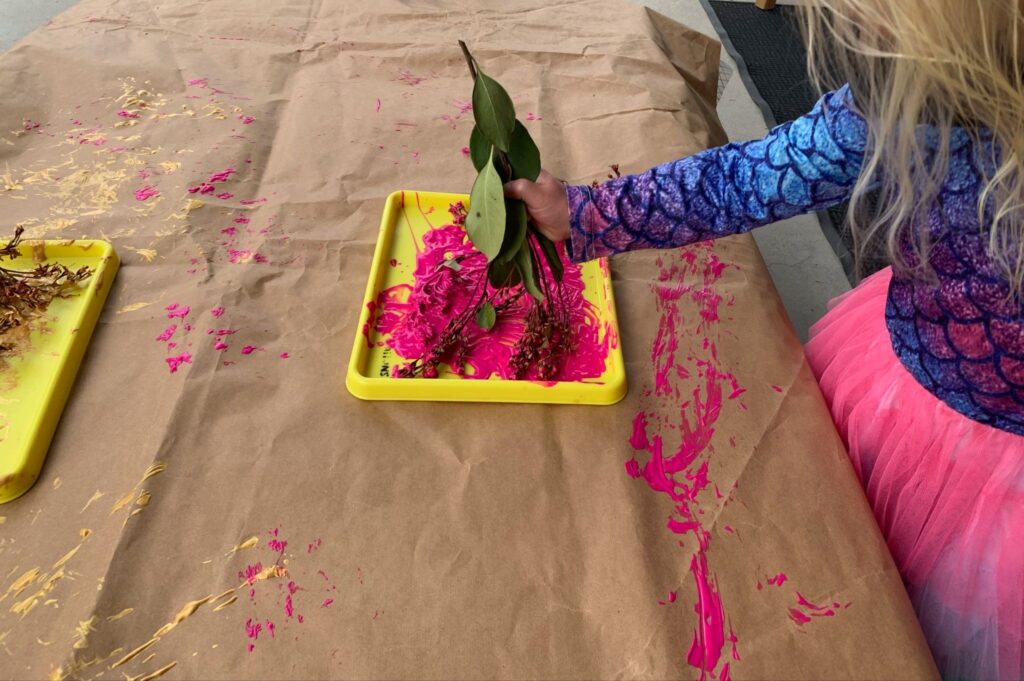
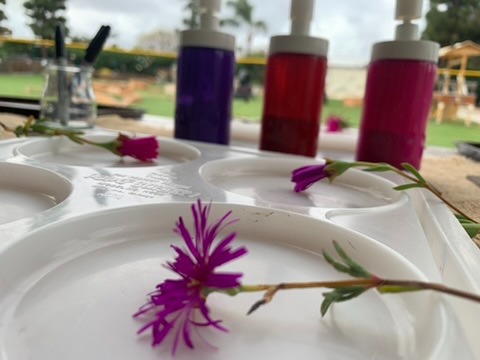
The paintbrushes were set aside. The flowers moved from subject to tool.
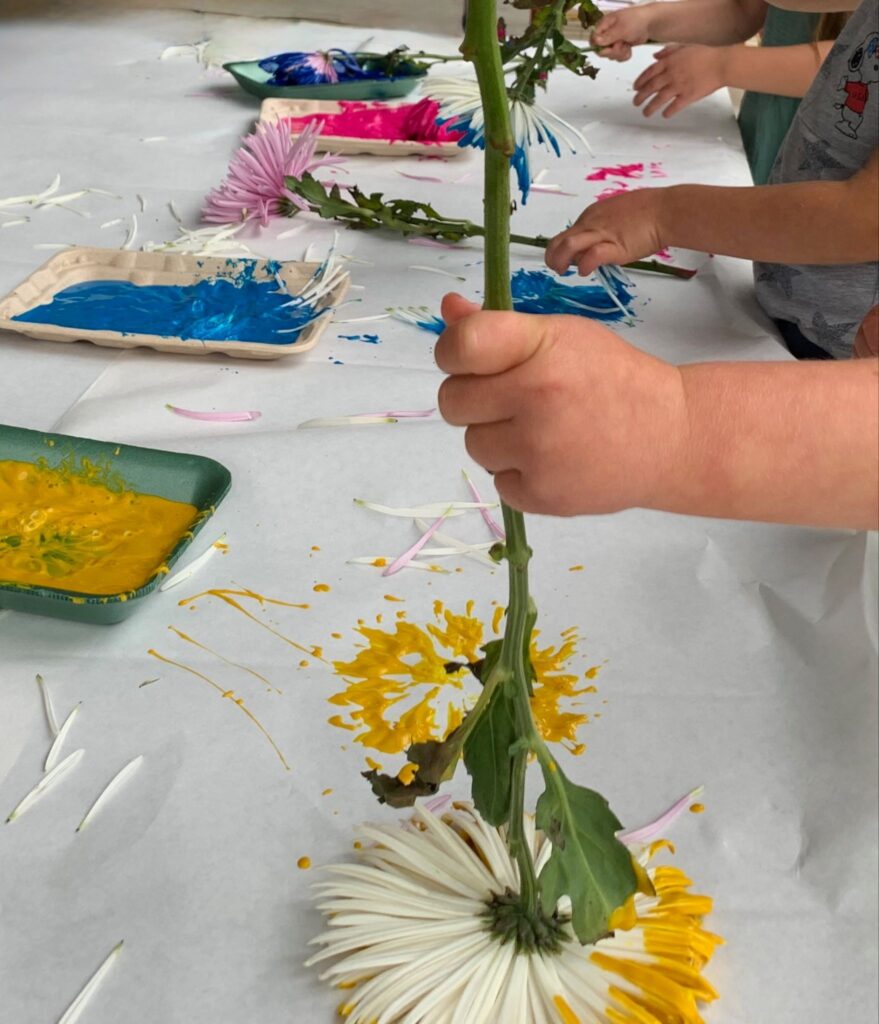
Petals were dipped into paint. Stems dragged gently across the surface. Leaves absorbed pigment and released it unevenly. Some marks were bold; others barely visible. The flowers resisted control, bending, tearing, or leaving only traces of color behind.
Children adjusted their movements in response. They slowed down. They pressed more carefully. They noticed that each flower made different marks and that the same flower never painted the same way twice.
Nature was no longer being represented. It was participating.
From Observation to Relationship
This shift—from painting what is seen to painting with what is seen—deepened children’s relationship with the materials. They compared the marks made by petals to the reflections they had been painting moments before.
“This one looks like the mirror one,” a child shared.
“This flower makes soft lines,” another observed.
Children were no longer just translating perspective; they were in dialogue with it.
Children’s Meaning-Making
As the work continued, children revisited earlier paintings, adding flower-made marks alongside brushstrokes. Layers emerged—observation layered with experience, reflection layered with touch.
The paintings became records of inquiry rather than products. They held questions, experiments, and discoveries. Each mark carried the story of how it was made.
The Educator’s Role
This work required us to follow, not lead. The jump from perspective painting to using flowers as brushes was not planned—it was listened into being.
Our role was to notice the question, honor the language children used, and allow the provocation to evolve in response. By doing so, we communicated trust in children’s thinking and respect for the materials they were engaging with.
Why This Matters
When children are allowed to shape the direction of learning, they experience agency. When nature is invited to participate rather than perform, children learn relationship, care, and responsiveness.
Art becomes less about outcome and more about encounter.
And learning becomes something that unfolds—petal by petal, question by question.
Call to Action
Listen closely to the questions children ask while they work. Notice when a material is asking to be used differently. How might you allow nature to lead the next step in your art provocations?